


Programme Introduction

Duration: 2 years (maximum duration: 4 years)
Yearly Intake: Not more than 40
Required Credits: 30 credits (including thesis)
Program Language: Chinese, English
Mode of Study: Full-time (Evening)
Endorsement in the Official Gazette: As referred to O Aviso consta do Boletim Oficial da RAEM, n.º 26, II Série, de 26 de 6 de 2024
Programme Aims
| 1. | In alignment with the educational philosophy of "From Personhood to Benevolence", to cultivate students into talents who can lead forward the development of nursing profession as expected by society; |
| 2. | To nurture students to apply research outcomes, innovate nursing practice, whereby prepare students for serving as experts who can take educative and leadership roles in clinical setting; |
| 3. | To prepare students for pursuing programmes of higher level. |
Programme Intended Learning Outcomes (PILO)
Upon completion of the Programme, graduates will be able to:
| 1. | Comprehensively apply and expand professional knowledge to solve complicated nursing problems with evidence-based approach. |
| 2. | Design multidisciplinary work plan to provide high-quality nursing service for individual, family and community. |
| 3. | Demonstrate the ability of applying the latest knowledge and technology to enhance the quality of nursing service. |
| 4. | Be equipped with the capacity of conducting academic research in related field. |
| 5. | Evaluate health-related issues and analyze health data and policy. |
| 6. | Acquire international insight and lead the development of Macao's nursing profession. |
Programme Structure
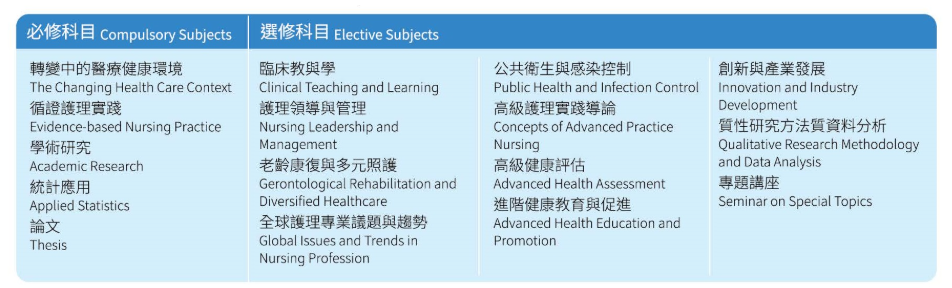
Entrance Requirements
| 1. | Hold a bachelor's degree in nursing; and |
| 2. | Have one year or more of nursing experience; or be outstanding fresh graduates holding bachelor's degree in nursing;and |
| 3. | Students must have participated in the most recent National Postgraduate Entrance Examination. The preliminary examination must meet national requirements.(Mainland Chinese Applicant) |
Teaching & Learning Methods
Programme Introduction
Interfaces with
1. Completion of specified courses in the College (total of 27 credits)
2. Completion of a thesis of Australia La Trobe University (total of nine credits)
3. Per programme requirements, complete a total of 36 credits with passing grades
4. Conferment of a Master of Nursing Programme graduation certificate from the two universities
Subjects :
Take classes and complete the thesis (total of nine credits) at Australia La Trobe University (through face-to-face classes) or (online lessons) in the second year of study
Lesson Mode :
The teaching method is local face-to-face classes/online lessons
Application Period :
March – May every year (lessons start on mid-July)
Application Documents and Procedures :
1. Log in to the online application system and upload the following information (please use coloured and scanned files)
‧ Transcript
‧ English proficiency exam result
‧ ID/passport
2. After receiving the acceptance letter, sign and upload it to the application system
3. Settle relevant tuition fees and other fees (if any)
Tuition Fees
1. Settle the two-year KWNC Master of Nursing Programme tuition fees
2. Settle additional fees for nine credits of Australia La Trobe University thesis course
With reference to the fee standard for the 2021-2022 academic year, it is AUD16,000. 'Remarks: there might be minor adjustment to tuition fees every academic year'
(The College also subsidises 15%-25% of the abovementioned expenses according to the annual situation)
3. If students select to study in Australia, they should be aware of the accommodation fees and living expenses
Australia La Trobe University official website
(English) https://www.latrobe.edu.au/
(Chinese) http://www.latrobeuniversity.cn/
Contact Us
Contact: Academic Secretary Ms. Ng
Tel:(853) 8295 6201
Fax: (853) 2836 5204
Email:[email protected]
Entrance Requirements
2. Completed four compulsory subjects and two designated electives in the first academic year.
3. A total of 6.5 points in IELTS and no lower than 6 points in each component.
(Proposed to be launched in the 2024/2025 academic year)
Programme Introduction
Duration: 2 years (maximum duration: 4 years)
Yearly Intake: Not more than 40
Required Credits: 30 credits
Program Language: Chinese, English
Mode of Study: Full-time (Evening) * Normally scheduled on Mondays to Fridays (two to three evenings) / Saturdays.
Degree awarded: Master of Applied Gerontology (MAG)
Programme Aims
In alignment with the educational philosophy of “From Personhood to Benevolence”:
| 1. | To cultivate students into talents who have comprehensive knowledge and practical ability in gerontology for Macao and the Greater Bay Area, in order to face the challenges of an ageing society. |
| 2. | To nurture students with the ability for reflection and to apply research outcomes, to make recommendations for ageing policy and innovate practice. |
| 3. | To cultivate students to have the ability of lifelong learning, in order to prepare students for pursuing programmes of higher level. |
Programme Intended Learning Outcomes (PILO)
Upon completion of the Programme, graduates will be able to:
| 1. | Comprehensively apply and expand professional knowledge to solve complicated ageing problems with evidence-based approach. |
| 2. | Design multidisciplinary work plan to provide high quality holistic care for older adults and their family. |
| 3. | Demonstrate the ability of creative thinking and applying the latest knowledge and technology to enhance the quality of senior service. |
| 4. | Be equipped with the capacity of conducting academic research in related field. |
| 5. | Evaluate ageing-related issues and analyze the quality-of-life data of older adults and ageing policy, in order to advocate the active ageing society. |
| 6. | Acquire international insight and lead the development of gerontology profession in Macao. |
Programme Structure
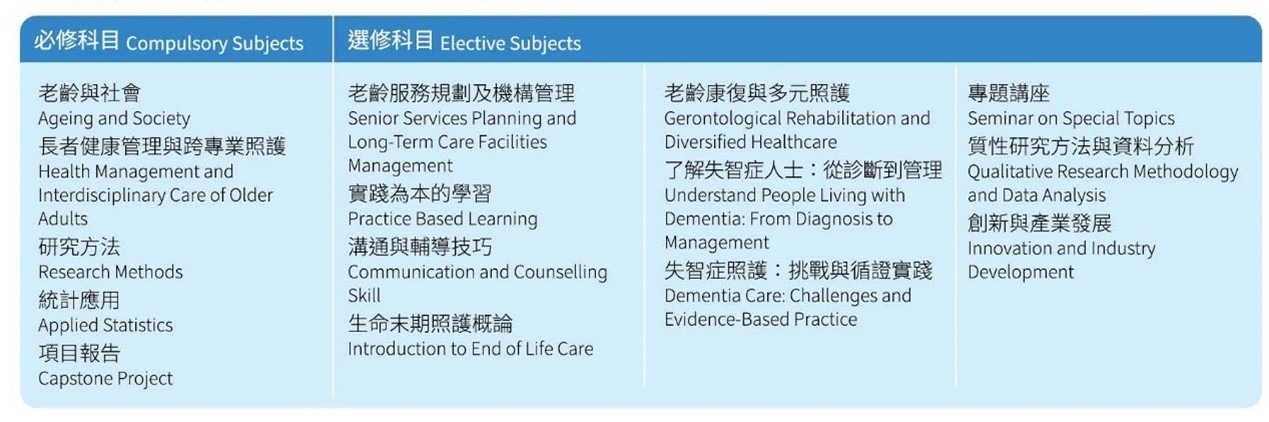
Entrance Requirements
| 1. | A Bachelor's Degree or equivalent qualification recognised by the Academic Committee. Preference will be given to holders of a Bachelor's Degree in a health or social work related discipline (e.g. Medicine, Nursing, Social Work, Physiotherapy, Occupational Therapy, Counselling, etc.). |
Teaching & Learning Methods
(Proposed to be launched in the 2024/2025 academic year)
Programme Introduction
Duration: 2 years (maximum duration: 4 years)
Yearly Intake: Not more than 30
Required Credits: 30 credits
Program Language: Chinese, English
Mode of Study: Full-time (Evening)
Degree awarded: Master of Advanced Nursing Practice (MANP)
This programme of study has been pre-approved by the Secretary for Health Bureau in accordance with Article 6(3) of the Regulation on Specialist Training in Nursing, Annex II of the Administrative Regulation 45/2021 "Regulations for the Implementation of the Procedures for Specialist Training in Medicine and Nursing", as the foundation training for specialist training in nursing, and is only applicable to those students who have fulfilled the above criteria at the time of enrolment in this programme:
— Resident of Macao;
— Hold a certificate of recognition of nursing qualification issued by a competent authority in Macau;
— Have at least three years of clinical nursing experience in a hospital, community health centre and/or community health service organisation in Macao.
Programme Aims
| 1. | In alignment with the educational philosophy of “From Personhood to Benevolence” to cultivate students into nursing experts within the realm of their nursing specialty practice; |
| 2. | To nurture students to apply research output, innovate nursing practice, in order for them to take educative roles and lead the development of their realm of nursing specialty; |
| 3. | To prepare students for pursuing programmes of higher level. |
Programme Intended Learning Outcomes (PILO)
Upon completion of the Programme, graduates will be able to:
| 1. | acquire conversant and professional nursing abilities to ensure nursing assessment, plan, implementation and evaluation for special group are carried out; |
| 2. | participate in transdisciplinary teamwork plan and implement activity plan formulated for achieving mutual healthcare aims in the team; |
| 3. | demonstrate the ability to evaluate, apply research output, new knowledge and novel technology in order to continuously improve nursing quality. |
| 4. | demonstrate management and leadership technique to promote the quality of nursing. |
| 5. | acquire international insight and lead the development of Macao’s nursing profession. |
Programme Structure
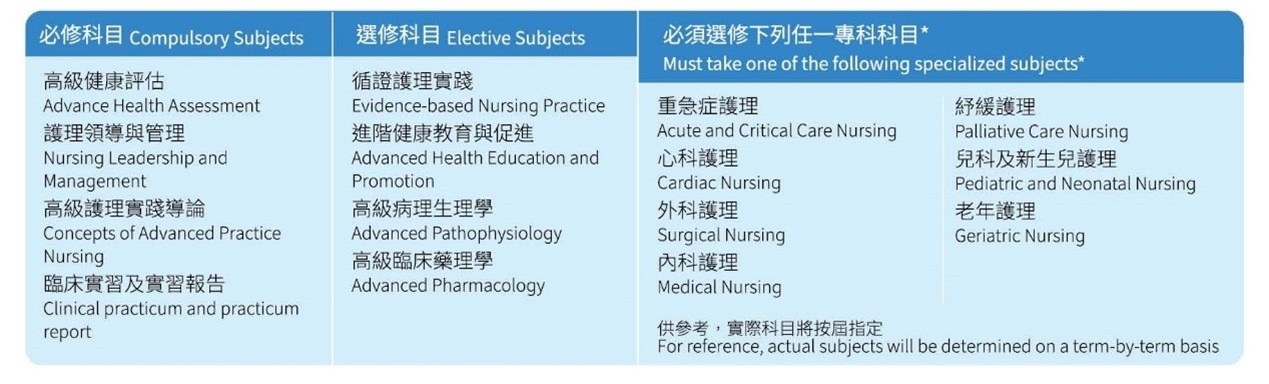
Entrance Requirements
| 1. | a Bachelor's degree in Nursing from a tertiary institution; and |
| 2. | at least three years of clinical nursing experience. |
Teaching & Learning Methods
Programme Introduction
Duration: 2 years (maximum duration: 4 years)
Yearly Intake: Not more than 40
Required Credits: 30 credits (including thesis)
Program Language: Chinese, English
Mode of Study: face-to-face study
Mode of Study: Full-time (Evening)
Endorsement in the Official Gazette: (2025年7月23日出版的第30期第II組 <<澳門特別行政區公報>>)
Programme Aims
| 1. | Equip students with academic knowledge and critical thinking skills to become competent managers/leaders of health related organisations. |
| 2. | Provide students with professional education in leading nursing practice and optimising health outcomes. |
| 3. | Apply advanced knowledge in systems thinking, scholarship, technology and evidenced base practice for contemporary issues in healthcare organisation. |
| 4. | Develop leadership capacity in students that enable them to implement transformative changes while maintaining nursing excellence within the challenging work environment. |
Programme Intended Learning Outcomes (PILO)
Upon completion of the Programme, graduates will be able to:
| 1. | Understand advanced management concepts and knowledge of leadership that are applicable in nursing systems and settings. |
| 2. | Develop social responsibility, critical thinking, sustained interest, technological literacy and management skills in nursing systems. |
| 3. | Apply interdisciplinary knowledge to develop abilities in addressing the competitive and dynamically changing nursing practice environment. |
| 4. | Integrate knowledge, skills and analytical thinking as well as problem solving abilities that are critical to future growth of healthcare industry. |
| 5. | Acquire international insights and global perspectives to address ever-changing nursing practices and challenges. |
Programme Structure
| Subject | Credit | Continuous Assessment (%) | Examination (%) |
|---|---|---|---|
| Compulsory Subjects | |||
| Management and Leadership in Healthcare | 3 | 100 | — |
| Understanding Nursing Services and Financial Management | 3 | 100 | — |
| Effective Resources Allocation and Utilisation in Nursing | 3 | 100 | — |
| Quality and Safety Management in Healthcare | 3 | 100 | — |
| Ethical and Legal Concerns for Nursing Leaders | 3 | 100 | — |
| Capstone Project | 6 | 100 | — |
| Elective Subjects (Select three) | |||
| Evidence-based Nursing Practice | 3 | 100 | — |
| Global Issues and Trends in Nursing Profession | 3 | 100 | — |
| Health Emergency and Crisis Management | 3 | 100 | — |
| Influencing and Leading Change at Work | 3 | 100 | — |
| Public Health and Infection Control | 3 | 100 | — |
| The Changing Health Care Context | 3 | 100 | — |
Entrance Requirements
| 1. | Applicants should possess an undergraduate degree in nursing from a recognized institution; or with an undergraduate degree in healthcare related disciplines; and |
| 2. | Preference for applicants who possess 2 years of work experience in healthcare related organisation/settings or those with managerial functions; |
Teaching & Learning Methods
Strive for Competence and Integrity
Serve with Professionality and Care


Complexo de Cuidados de Saúde das Ilhas
Edifício do Instituto de Enfermagem Kiang Wu de Macau, Avenida do Hospital das Ilhas no.447, Coloane, RAEM
Permanent Campus
Est. Repouso No. 35, R/C, Macau


官網instagram


掃描二維碼關注官方微信
Institutional Accreditation (IA) &Nursing Education Accreditation
 |
 |
 |
| The Quality Assurance Agency for Higher Education (QAA): Institutional Accreditation |
The Motherland's Education Quality Evaluation Agency of the Ministry of Education:
Nursing Education Accreditation |
Course provider of Alzheimer's Disease International (ADI) |
